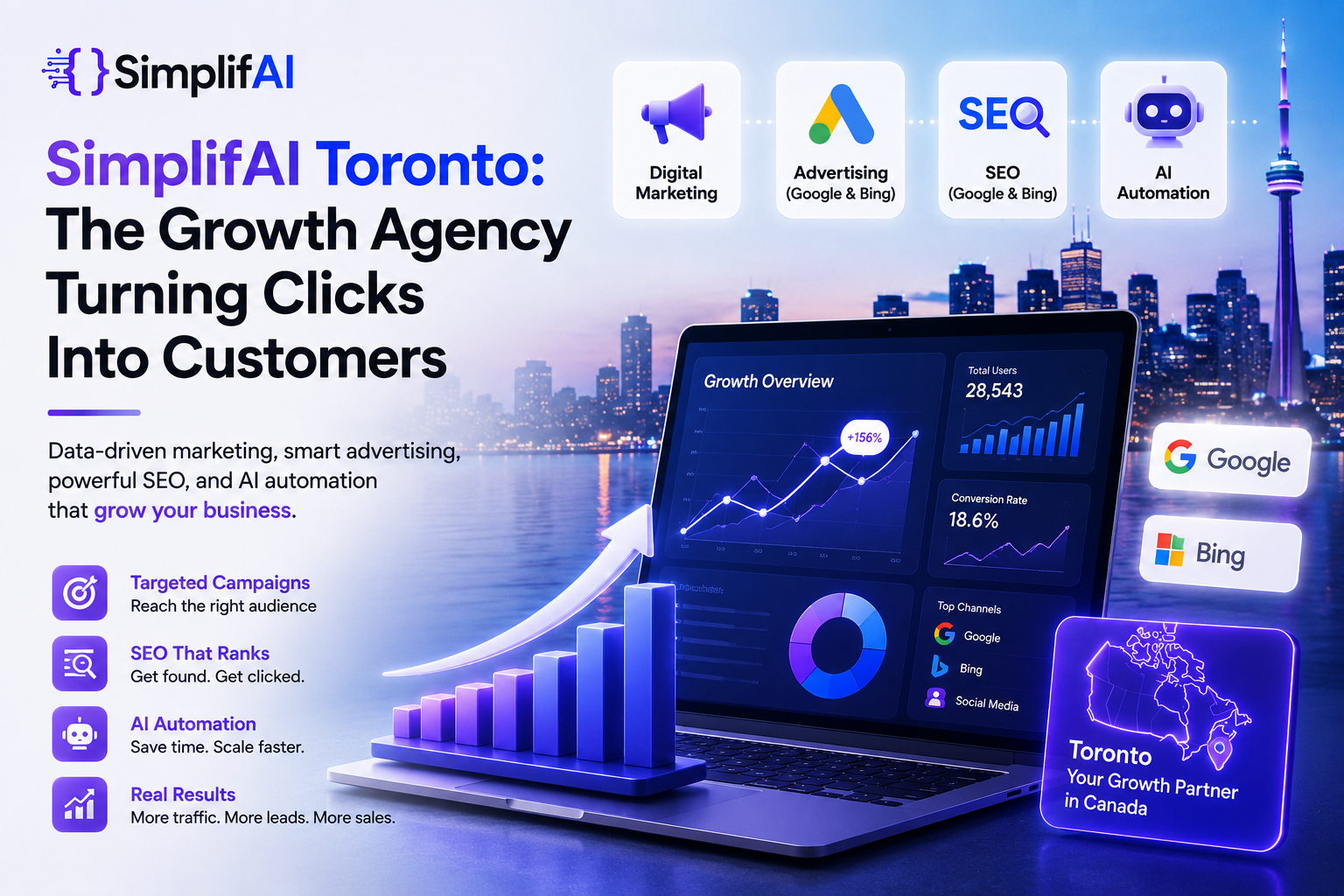

Most agencies sell you services. SimplifAI builds you a system.
That’s the real difference. Based in Scarborough, Toronto, SimplifAI calls itself “Toronto’s Growth Agency,” and the name fits. Instead of handing you a list of tasks like SEO, ads, or a new website, they connect all of it into one working engine. Your website, your ad accounts, your CRM, all wired together so interested visitors turn into booked calls and closed deals without someone manually chasing every lead.
If you’ve ever felt like your marketing tools don’t talk to each other, this is the problem SimplifAI was built to solve. You run ads that generate leads, but those leads sit in a spreadsheet nobody checks. You rank for a few keywords, but your site doesn’t actually convert visitors once they land. You automate one workflow, but three other manual processes still eat up your team’s week. SimplifAI’s entire pitch rests on fixing that disconnect, not adding one more disconnected tool to the pile.
The Problem Most Toronto Businesses Actually Have
Before getting into what SimplifAI does, it helps to understand why a business would need an agency like this in the first place.
Most small and mid-sized businesses in Toronto, and honestly most businesses anywhere, don’t have a marketing problem. They have a systems problem. They’re running Google Ads through one platform, tracking leads in a CRM that doesn’t sync with their website, managing SEO through a freelancer who never talks to the ad manager, and handling customer follow-up manually because nothing is automated.
Each piece might work fine on its own. But growth doesn’t come from isolated pieces working fine. It comes from those pieces working together, feeding each other data, and removing the manual steps that slow everything down. That’s the gap SimplifAI positions itself to close, and it’s why their homepage doesn’t lead with “we do SEO” or “we run ads.” It leads with automating growth and freeing up time, because that’s the actual outcome a business owner wants.
What Does SimplifAI Actually Do?

Think of SimplifAI as five services working as one machine, not five separate vendors you have to manage.
Search Engine Optimization (SEO)
SimplifAI builds long-term organic visibility by matching content to real search intent and the buyer’s journey. This isn’t about stuffing keywords into a page and hoping Google notices. It’s about understanding what someone in your city is actually typing into Google when they’re ready to buy, then building the pages, structure, and authority signals that answer that search better than your competitors do.
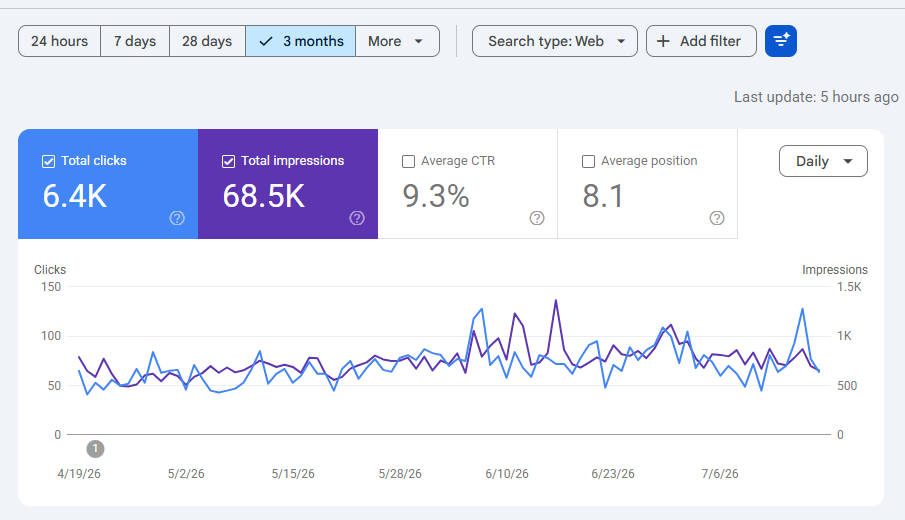
Their SEO work leans heavily on a Google Business Profile-first approach for local businesses, which means your map pack presence, your citations, your reviews, and your on-page local signals all get treated as one coordinated system rather than an afterthought. For service-based businesses that depend on local search, this matters more than almost anything else they offer.
Google and Meta Ads
Paid campaigns designed to validate messaging fast and generate predictable demand, not just spend a budget and hope something sticks. The idea here is that ads shouldn’t run in isolation from your organic strategy. If SEO is building long-term demand, ads are there to accelerate reach in the short term and test which messaging actually resonates before you scale it further.
This combined approach means a business isn’t waiting six months for organic traffic to kick in with nothing happening in the meantime. Ads fill the gap while SEO compounds in the background.
AI and Automation Services
This is where SimplifAI genuinely stands apart from a typical marketing agency. They connect your existing tools and workflows so your team stops doing repetitive manual work. That could mean automating how leads get routed from your website to your sales team, automating follow-up emails and texts after a form submission, or building custom workflows using tools like n8n to replace fragmented manual processes entirely.
Their own case studies show this in action. They automated their internal recruitment process using n8n, replacing fragmented tools with a system that handles applicant tracking and onboarding without someone manually moving candidates through a spreadsheet. That’s not a client pitch. That’s them using their own product on their own business, which says something about how much they trust it.
Workflow Automation
Once traffic is coming in, SimplifAI refines your pages, messaging, and user flow so more of that traffic actually converts into paying customers. This is the conversion optimization layer that a lot of agencies skip entirely. It’s one thing to drive traffic to a website. It’s another thing to make sure that traffic doesn’t bounce off a confusing page or an unclear call to action.
Product and UI/UX Design
Clean, user-first design work grounded in research, not guesswork. Every layout decision ties back to what actually gets a visitor to say yes. This service exists because a beautiful website that doesn’t convert is just an expensive brochure. SimplifAI’s design process starts with understanding user behavior and decision triggers, then builds a design system around that instead of picking a template and filling in the blanks.
Web App Development
Fast, modern websites and web apps built to support marketing, not just look good sitting on a server. Several of their case studies, including Bail Express and Dream Kitchen, show businesses moving from outdated platforms like Wix to a properly built WordPress site with analytics and ad tracking built in from day one.
They also built their own in-house platform called Rankify, which uses AI to speed up SEO research and content planning. That’s a business investing in its own tools, not just reselling someone else’s software. When an agency builds internal tools to make their own delivery faster, it usually means they’ve hit scaling problems themselves and solved them, which is a very different starting point than an agency that’s never had to scale past a handful of clients.
How the Process Works
SimplifAI runs every client through the same three-stage framework, and this structure is worth understanding because it’s the actual mechanism behind their results, not just marketing language.
Stage One: Discovery
They start by understanding your audience, reviewing what’s currently working (or not), and setting clear success metrics tied to actual business outcomes, not vanity numbers. This stage involves clarifying who your target customer actually is, what motivates their decision, and what’s currently getting in the way of conversion.
A lot of agencies skip this step or rush through it because it doesn’t feel like “real work.” SimplifAI treats it as the foundation everything else gets built on, which makes sense. You can’t design a system to hit a target you haven’t defined.
Stage Two: System Design
Next, they map out your funnel, decide how data and tracking should flow, and prioritize what to build first based on impact. This is where the actual architecture gets planned: which channels feed which stages of your funnel, how attribution works so you know which marketing dollar actually produced a customer, and what gets built first versus what can wait.
This stage is also where the automation planning happens. If your business needs a workflow that routes leads automatically or triggers follow-up sequences, this is where that gets mapped out before a single line of code gets written.
Stage Three: Launch and Acceleration
Then they build fast: pages, campaigns, integrations, all tested before going live and monitored once they do. This isn’t a “launch and walk away” model. Everything gets validated against clear testing criteria before it goes live, and once it’s live, performance gets tracked so adjustments happen based on real data rather than guesswork.
This structure matters because it means growth isn’t left to chance. It’s repeatable, which means a strategy that works for one client can be adapted and reapplied for the next one, refined each time based on what actually worked.
Why Businesses Choose SimplifAI
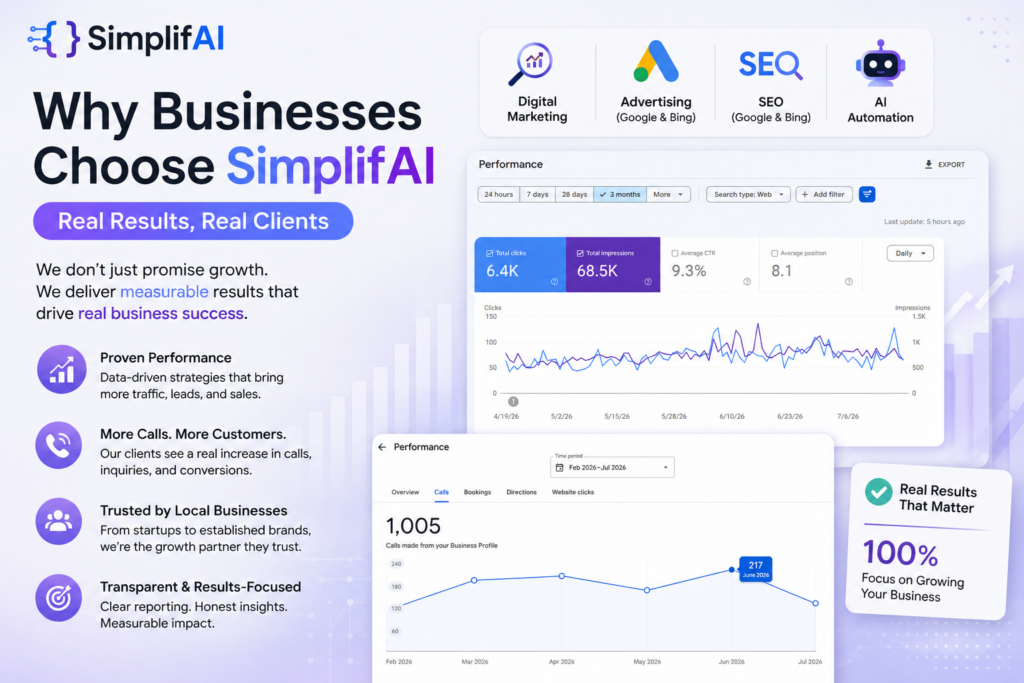
Real Results, Real Clients
Companies like Bail Express, Dream Kitchen, Works By JD, Utopiads, TMM Yacht Charters, and Huron Industries have documented case studies showing measurable gains in leads, rankings, and site performance across very different industries.
Bail Express saw a faster, more modern website with proper analytics and Google Ads integration built in, which led to better quality leads and actual performance tracking, something they didn’t have before. Dream Kitchen, a luxury remodeling business, got a website that finally matched the quality of the work they deliver, with a mobile experience that made it easier for clients to book consultations. Works By JD moved from Wix to WordPress and saw better rankings along with automation and chatbot support that saved the team time on high-end remodeling inquiries.
On the SEO side, Utopiads expanded across multiple cities by launching hundreds of optimized service pages and strengthening local signals, which increased visibility and cross-border lead flow. TMM Yacht Charters used a Google Business Profile-first approach to improve discoverability in the BVI market, leading to more qualified charter enquiries. Huron Industries, operating in a niche industrial space, got a full site restructure along with ongoing content and authority building that steadily improved local visibility and product discoverability.
These aren’t generic testimonials. Each one describes a specific mechanism (a GBP-first strategy, a multi-city page expansion, a platform migration) tied to a specific, believable outcome. That’s a meaningfully different signal than an agency that just says “we grew their traffic.”
A 4.8 Google Rating
That kind of consistency doesn’t happen by accident. A strong average rating across enough reviews usually reflects a pattern of clients who felt the work delivered what was promised, not a handful of cherry-picked five-star reviews.
One Team, Not Five Vendors
SEO, ads, design, development, and automation all under one roof means no finger-pointing when something doesn’t line up. If your SEO traffic isn’t converting, the same team that built your pages can look at the design and the automation behind it, instead of three separate vendors blaming each other while nothing gets fixed.
This matters more than it sounds. A lot of the friction in marketing comes from coordination failure, not strategy failure. When your ad agency, your web developer, and your SEO consultant are three different companies who’ve never spoken to each other, things fall through the cracks constantly. Consolidating that under one system removes an entire category of failure points.
They Build Their Own AI Tools
Rankify for SEO, an n8n-powered recruitment automation system, and a RAG-based Notion AI assistant show a team that uses automation internally, not just sells it. Their internal Notion AI assistant pulls source-cited answers from Notion and Google Drive, saving their own team time on manual searches and helping them make faster decisions. This is the kind of detail that’s easy to skip past, but it tells you something real: an agency that automates its own operations understands automation at a level deeper than one that just implements templates for clients.
A Transparent Process
You know exactly what phase you’re in and what happens next. Their FAQ section addresses the practical concerns most business owners actually have before signing up: what SimplifAI actually handles, how long implementation takes, whether the team will need training, and whether existing tools need to be replaced.
On that last point, their answer is worth highlighting. They don’t push for a full teardown of your existing stack just to sell you new software. Their approach is to integrate with what you already use and improve how those tools work together, only recommending a replacement if something is genuinely limiting performance. That’s a more sustainable approach than an agency that pushes a proprietary platform on every client regardless of fit.
A Closer Look at Who This Is For
SimplifAI works best for growing businesses that want to reduce manual processes, improve response times, and create more consistent operations. If your team is spending too much time on repetitive tasks or disconnected systems, automation can create an immediate impact.
In practice, this tends to describe a few kinds of businesses particularly well.
Service-based businesses with local demand. If you’re a plumber, a remodeling company, a charter service, or any business where customers search locally before buying, the GBP-first SEO approach combined with a properly automated lead follow-up system can be the difference between a lead that converts and one that goes cold because nobody responded fast enough.
Businesses outgrowing their current website. Several of SimplifAI’s case studies involve companies moving off platforms like Wix onto a properly built WordPress site. If your current site was built years ago, isn’t tracking anything meaningful, and doesn’t reflect the quality of what you actually deliver, this is a common starting point for engagement.
Businesses expanding into new markets. The Utopiads case study, where a company launched hundreds of service pages across multiple cities, shows SimplifAI can handle scale when a business needs to establish local relevance in several markets at once rather than just one.
Teams drowning in manual admin work. If your team spends hours a week on tasks that could be automated (lead routing, applicant tracking, internal knowledge lookups) the automation and AI services are built specifically for that kind of operational drag.
What Sets This Apart From a Typical Marketing Agency
The easiest way to understand SimplifAI’s positioning is to compare it to what most businesses experience with a typical agency relationship.
A typical SEO agency will optimize your pages and hand you a monthly report showing keyword rankings. A typical ad agency will run your campaigns and report on cost per click. A typical web developer will build your site and move on to the next client. Each of these relationships treats the deliverable as the end goal.
SimplifAI’s model treats the deliverable as one part of a larger system. The SEO work feeds into the same funnel the ads are driving traffic toward. The website isn’t just a design exercise, it’s the conversion layer that determines whether all that traffic actually turns into revenue. The automation isn’t a side project, it’s what makes sure a lead generated at 11pm gets a response before a competitor gets to that same customer first.
This is also why their process starts with Discovery instead of jumping straight into execution. A typical agency pitch starts with “here’s what we’ll build.” SimplifAI’s starts with “here’s what’s actually happening in your business right now, and here’s where the gaps are.” That difference in starting point tends to produce very different long-term results, because a system built around your actual gaps performs differently than a generic service package applied to every client regardless of fit.
Common Questions Before Getting Started
Anyone considering an agency like this usually has the same handful of questions, and SimplifAI addresses them directly rather than leaving prospects to guess.
What does SimplifAI actually handle for us?
They manage the full setup and implementation of your automation systems. They design the workflows, connect your tools, and launch everything in a way that fits your current operations, with the stated goal of reducing manual work and improving efficiency without disrupting how your team already operates.
How long does it take to launch everything?
Timelines depend on scope and complexity. A smaller automation project can launch quickly, while more advanced integrations across multiple tools need additional planning and testing. The important part is that clients get a clear rollout plan before work begins, so there’s no ambiguity about what to expect and when.
Will our team need training?
Yes, but it’s kept simple and practical. Systems are built to be intuitive, with clear guidance so teams can adopt new workflows with confidence. Most teams adjust quickly because the systems are designed to make daily work easier, not add another layer of complexity on top of what they already deal with.
Do we need to replace our current tools?
Not necessarily. In most cases, SimplifAI integrates with the tools a business is already using and improves how those tools work together. A replacement only gets recommended if something is genuinely limiting performance, not as a default upsell.
What kind of businesses is SimplifAI best suited for?
Growing businesses that want to cut down on manual processes, improve how fast they respond to leads, and build more consistent day-to-day operations. If a team is losing time to repetitive tasks or systems that don’t talk to each other, this is exactly where automation tends to create fast, visible impact.
Why the System-First Approach Actually Matters
It’s worth sitting with why this matters more than it might seem at first glance. Most businesses that reach out to a marketing agency are already running some version of marketing. They have a website. They’re probably running some ads. Maybe they’ve dabbled in SEO. The failure point usually isn’t a total absence of effort, it’s that none of these pieces reinforce each other.
A website that isn’t tracking conversions properly means ad spend gets judged on the wrong numbers. An SEO strategy that isn’t tied to a clear conversion path means rankings go up while revenue stays flat. A lead capture form with no automated follow-up behind it means a percentage of every campaign’s results simply evaporate because nobody responded in time.
SimplifAI’s structure is built around closing those specific gaps, not around selling a bigger version of any one service. That’s a meaningfully different value proposition than “we’ll do your SEO” or “we’ll manage your ads.” It’s closer to “we’ll fix the reason your marketing isn’t compounding,” which is a harder problem to solve but a far more valuable one when it’s solved correctly.
The Bottom Line
SimplifAI isn’t just another marketing agency. It’s a growth infrastructure partner that combines strategy, design, and automation into one engine built to scale your business without scaling your workload.
For a Toronto business tired of managing five different vendors, watching leads fall through the cracks, or wondering why traffic isn’t turning into revenue, this kind of connected system-first approach addresses the actual root problem instead of another symptom. Whether the entry point is SEO, ads, a new website, or pure automation, the underlying goal stays the same: build a system that keeps working long after the initial project wraps up, so growth stops depending on constant manual effort and starts running on its own.
Businesses interested in seeing how this could work for their own operations can get in touch with the SimplifAI team to walk through where the gaps are and what a system built around them would look like.